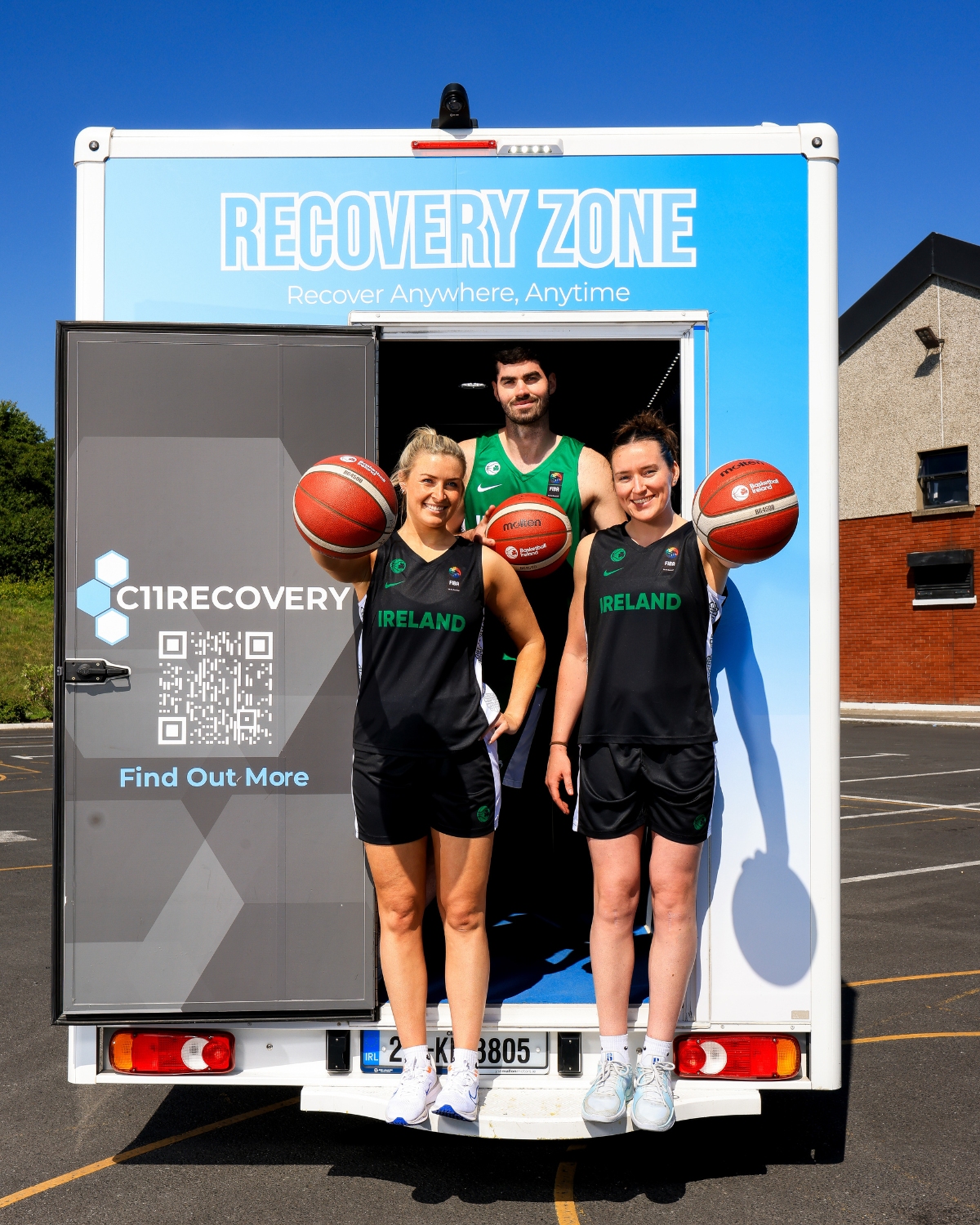
C11 is proud to support Irish elite basketball as an Official Recovery Partner of Basketball Ireland.
At national team level, recovery is not optional. It is structured, scheduled and embedded into the performance cycle. The same attention given to tactical preparation and skill development is applied to how athletes recover.
Below the national team, most clubs are working without that structure. Not because they don’t want it, but because the facilities aren’t there. Here’s what a basketball game actually does to a body, what the research says about recovering from it, and how a recovery truck closes the gap.
What a Basketball Game Actually Does to a Body
Basketball reads as a skill sport from the stands. The physiological data says otherwise.
A systematic review in Sports Medicine pooled the match-play research and found that in a 40-minute game, players cover 5–6km, at an average intensity above the lactate threshold and above 85% of maximum heart rate. Heart rate during live play sits between 161 and 186 beats per minute. Blood lactate runs between 2.7 and 6.8 mmol/L.
Two numbers matter more than the distance, though.
The first is the change of activity. Players switch movement pattern somewhere between 21 and 57 times per minute. Guards rack up over 1,100 individual movements in a game. Almost none of it is steady running — it’s accelerate, decelerate, cut, shuffle, jump, land, repeat.
The second is jumping. Roughly one jump for every minute of play. Every one of those has a landing attached to it, and the landings are where the eccentric load lives. That is the damage a player is carrying into the next day, and it is why basketball soreness sits in the legs.
The Turnaround Is the Problem
Damage from one game isn’t the issue on its own. The issue is how little time there is before the next one.
International basketball runs on windows. In the FIBA qualifying format, each team plays two games inside a nine-day window, usually home and away, with travel in between. A squad assembles, plays, travels, plays again, and disperses.
Domestic schedules compress the same way. Weekend doubles. Midweek cup games. Long bus journeys either side.
That’s the window recovery has to work in. Not “over the next fortnight” — before Sunday.
What the Research Says About Cold Water Immersion in Basketball
Most recovery evidence gets borrowed from other sports. Basketball has its own.
A study in the Journal of Sports Sciences put basketball players through competitive matches and then compared three conditions: intermittent cold water immersion, sports massage, and a control. The immersion protocol was specific — five rounds of two minutes in 11°C water up to the hip, with two minutes out of the water between each.
Cold water immersion came out ahead of both massage and control on perceived fatigue and leg soreness, and it protected countermovement jump performance where the control group’s dropped away.
Worth being straight about the other half of the result: nothing in that study improved repeated-sprint ability at 24 hours. Immersion made players feel better and jump better. It did not make them fresh.
That is the honest version, and it is still a strong case. In a sport built on jumping, protecting jump output between two games in a week is exactly the thing worth protecting. Our complete ice bath guide covers the wider evidence base.
High-Performance Recovery for Elite Teams
Our mobile recovery room is designed specifically for high-level basketball teams operating in competitive environments.
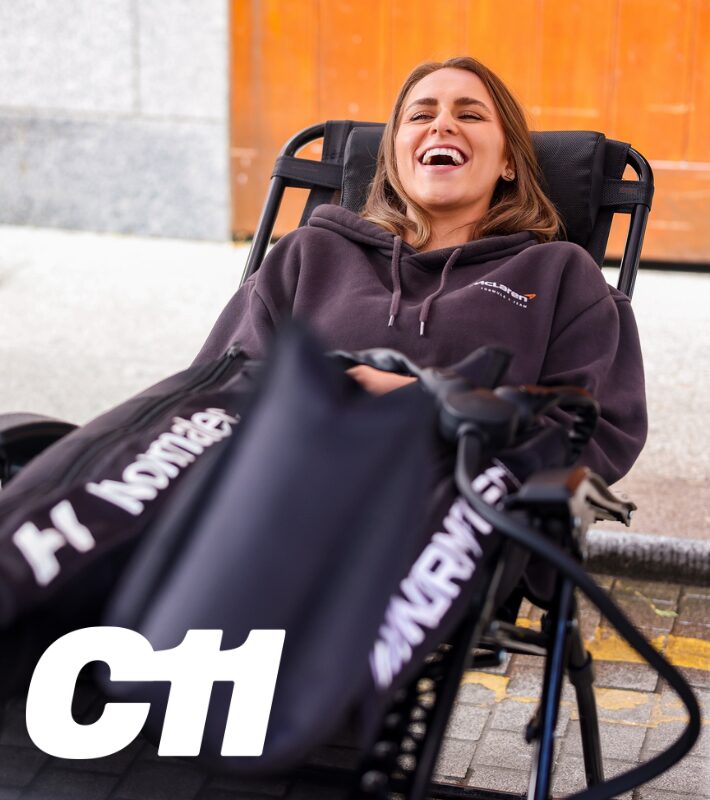
We deliver professional-grade cold immersion and compression therapy directly to your venue, allowing players to begin structured recovery immediately post-game or post-training.
On board:
- Ice baths
- Compression boots
- Massage guns
- Massage therapy
- Pre-prepped meals
- Nutrition supplements
How the C11 Recovery Truck Supports Basketball Teams
Not every club has access to permanent high-performance recovery facilities. The C11 Recovery Truck bridges that gap.
The Recovery Truck delivers a professional, structured recovery environment directly to teams post-match or post-training. With on-site cold immersion and compression therapy, players can begin recovery immediately while still in competition mode.
The point is the location. Recovery that happens at the venue, in the half hour after the final buzzer, is recovery that actually happens. Recovery that depends on players finding a facility the next day mostly doesn’t.
A Practical Recovery Routine for Basketball Teams
| What to do | Why | |
|---|---|---|
| Straight after the final buzzer | Cold immersion, around 11°C, five rounds of two minutes in with two minutes out | The exact protocol the basketball research used — lower perceived fatigue and leg soreness, and jump performance held onto |
| Same evening | Compression, soft tissue work and food, before travel | The hours after a game are the only uninterrupted window a squad gets before the journey home |
| Between games in a window | Repeat it, rather than saving it for the harder fixture | Across sports, the benefit of cold immersion builds with consistent use rather than one-off sessions |
| Off-season strength blocks | Leave a gap between heavy lifting and the cold | Immediate cold exposure after resistance training can blunt the muscle-building response — different goal, different timing |
Our beginner ice bath routine covers how to build up to those durations, and contrast therapy covers pairing cold with heat.
Frequently Asked Questions
Does cold water immersion actually work for basketball players?
Yes, for specific outcomes. A study in the Journal of Sports Sciences on basketball players found intermittent cold water immersion after matches beat both sports massage and a control on perceived fatigue and leg soreness, and protected countermovement jump performance. It did not improve repeated-sprint ability at 24 hours.
How cold and how long should a basketball ice bath be?
The basketball-specific protocol was five rounds of two minutes in 11°C water, immersed to the hip, with two minutes out of the water between rounds. Broader guidance across sports sits at 10–15°C for 10–15 minutes total.
Why does recovery matter so much in basketball specifically?
Players cover 5–6km in a 40-minute game above 85% of maximum heart rate, change movement pattern up to 57 times a minute, and jump roughly once a minute. In FIBA qualifying windows, teams play two games within nine days, so there is very little time for that load to clear on its own.
Should players use an ice bath after every game?
The evidence across sports supports consistent use through a demanding block rather than saving it for the hardest fixture. The exception is off-season strength work, where leaving a gap between heavy lifting and cold exposure is the better call.
What does the C11 Recovery Truck bring to a venue?
Ice baths, compression boots, massage guns, massage therapy, pre-prepped meals and nutrition supplements, set up on site so players start recovering within minutes of finishing.
Can a club book the recovery truck, or is it only for national teams?
Any club or squad can book it. The truck exists specifically for teams without permanent high-performance recovery facilities of their own.
Interested in a Recovery Session for Your Team?
Whether you are a player, a coach or a club looking after a squad, we will talk you through what a session looks like and what fits your schedule. Enquire about availability or get in touch and we will come back to you.