
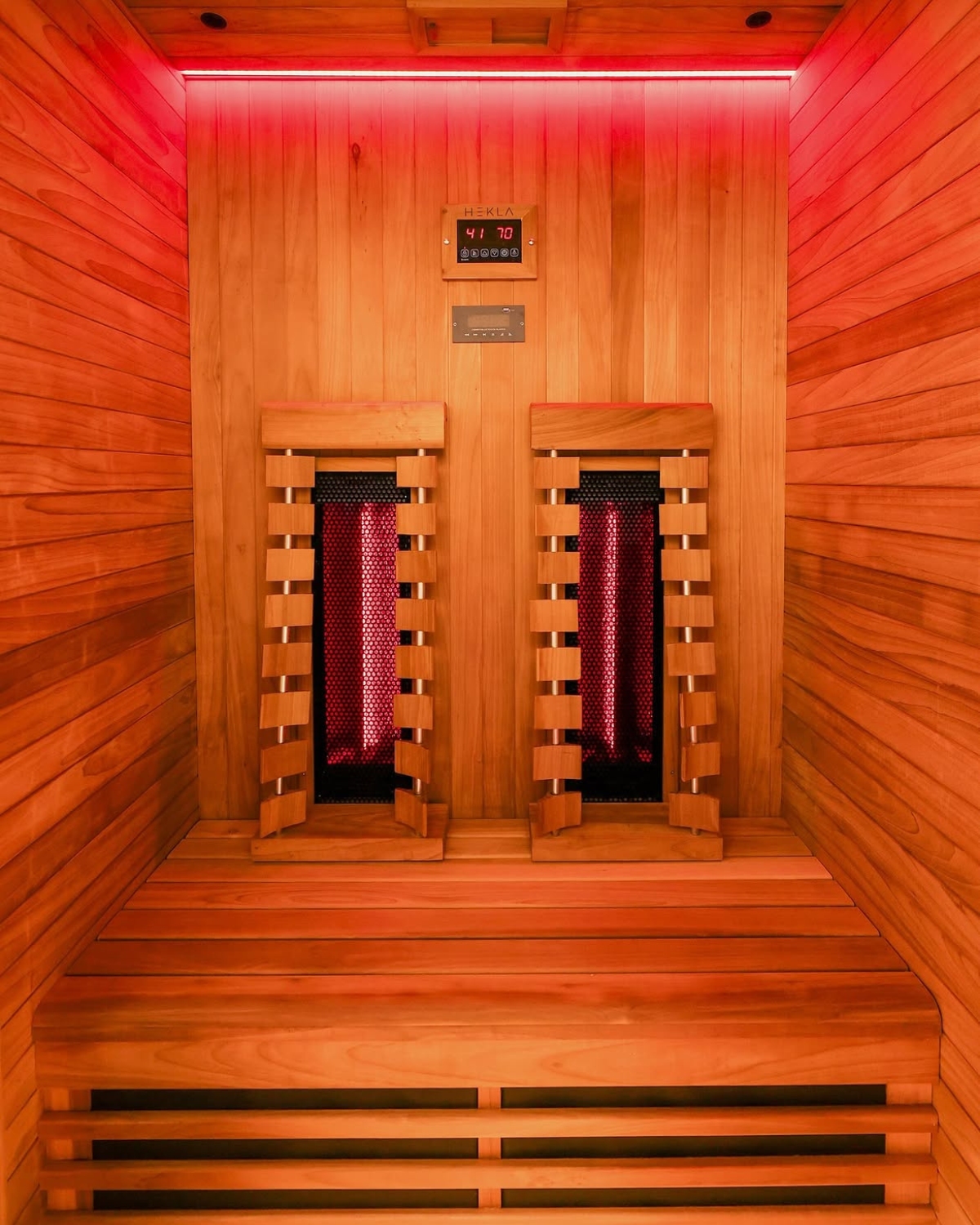
If you are weighing up a sauna for your home, the first real decision is not the size or the finish. It is the heat. A traditional sauna heats the air to 80–100°C with a stove and stones; an infrared sauna warms your body directly with panels at a far gentler 45–60°C. Both will make you sweat, both are good for you, and both are sold and installed by C11 across Ireland. But they feel different, cost different amounts to run, and suit different homes.
Here is the short version, then the detail.
Infrared vs traditional sauna: the quick answer
- Choose a traditional sauna if you want the full Finnish experience: proper heat, steam from water on the stones, room for family or friends, and the deepest heat-shock effect. It needs a dedicated electrical supply and a bit more space. See the indoor range.
- Choose an infrared sauna if you want something that plugs into a normal socket, warms up in minutes, runs for pennies and fits a spare room, apartment or home gym. It is a cooler, longer, more relaxed session. See the infrared range.
Neither is “better”. The right one is the one you will use four or five times a week. The rest of this guide helps you work out which that is.
How a traditional sauna works
A traditional sauna is a timber room with a heater, usually electric in an Irish home, that heats a bed of stones. The stones heat the air, the air heats you. Cabin temperatures sit between 80°C and 100°C, and when you ladle water onto the stones you get a burst of steam the Finns call löyly, which spikes the humidity and makes the heat feel more intense for a minute or two.
Every traditional sauna C11 supplies runs on a Harvia heater, the Finnish brand used in saunas worldwide. Our indoor models use the wall-mounted Harvia The Wall at 6 or 9 kW, with digital controls so you can set the temperature and a timer, and on the Wi-Fi version start heating from your phone before you get home. It takes around 30 to 45 minutes to reach temperature, which is part of the ritual for some people and a nuisance for others.
The research base behind sauna bathing comes almost entirely from this type of sauna. The long-running Finnish studies linking regular sauna use with lower cardiovascular risk were done in traditional, hot, dry-then-steamy saunas. We cover that in detail in what the research actually shows about sauna health benefits.
How an infrared sauna works
An infrared sauna does not try to heat the whole room. Full-spectrum infrared panels in the walls and under the bench emit radiant heat that is absorbed by your skin and the tissue underneath. The air around you stays at roughly 45°C to 60°C, so it feels warm rather than hot, but you still sweat heavily because the heat is going into you, not the air.
The practical differences follow from that. C11’s infrared saunas draw 1.5 kW (Infrared 100) or 2.4 kW (Infrared 130 and 160), plug into a standard 13 amp socket, and warm up in 10 to 15 minutes. There is no water, no steam, no stones and no dedicated electrical circuit. Because the cabin is cooler, most people stay in for 30 to 45 minutes rather than the 10 to 15 minute rounds of a traditional sauna.
The infrared research base is smaller and younger. Most of it comes from Japanese “Waon therapy” studies using infrared cabins at around 60°C for cardiac patients, with encouraging results for circulation, blood pressure and recovery. It is promising, but it is not yet the decades of population data that traditional saunas have.
Side by side: infrared vs traditional
| What matters | Traditional sauna | Infrared sauna |
|---|---|---|
| Cabin temperature | 80–100°C | 45–60°C |
| How it heats you | Hot air and steam from the stones | Radiant panels warm the body directly |
| Heat-up time | 30–45 minutes | 10–15 minutes |
| Typical session | 2–3 rounds of 10–15 minutes, with cool-downs | One 30–45 minute session |
| Steam and humidity | Yes, on demand | No, dry heat only |
| Power draw | 6–9 kW heater on a dedicated circuit | 1.5–2.4 kW from a standard socket |
| Electrician needed | Yes, registered electrician | No |
| Capacity | 2–6 people depending on model | 1–2 people |
| Indoor or outdoor | Both | Indoor only |
| C11 price range | €6,250–€8,665 (indoor) | €3,850–€5,150 |
| Research base | Large, decades of Finnish data | Smaller, growing |
Prices include VAT. Delivery and installation are quoted separately. See power and installation for what each type needs.
Heat and feel: what a session is actually like
This is the part no spec sheet captures. A traditional sauna is an event. You wait for it to heat, you go in, the air hits you, you pour water on the stones and the room roars. Ten or fifteen minutes is plenty. You step out, cool down, maybe go back in. Done with an ice bath between rounds, it is the hot-and-cold contrast that athletes and GAA clubs come to us for.
An infrared sauna is quieter. The cabin never feels oppressive, so you can read, listen to something, or just sit for forty minutes while the sweat builds slowly. People who find a traditional sauna too much, or who want to use a sauna daily without the ceremony, tend to prefer it. People who love real heat sometimes find infrared underwhelming.
If you have access to both, try both before you buy. If you do not, be honest about which description sounds like something you would do on a wet Tuesday in February.
Health benefits: traditional vs infrared
Both types raise your core temperature, raise your heart rate, dilate blood vessels and make you sweat. Those are the mechanisms behind most of the claimed benefits: better circulation, lower blood pressure over time, muscle relaxation, improved sleep and stress relief.
Where they differ:
- Cardiovascular evidence is strongest for traditional saunas, because that is where the large, long-term studies were done. The Finnish KIHD cohort found that men who used a sauna four to seven times a week had markedly lower rates of fatal cardiovascular events than once-a-week users.
- Heat tolerance favours infrared. Because the air is cooler, people who feel faint or breathless in a hot sauna can still get a long, sweaty session.
- Muscle recovery is where infrared makes its strongest case. The radiant heat penetrates a few millimetres into tissue, and the longer sessions suit post-training use. Traditional saunas work for recovery too, especially paired with cold.
- Detox claims you will see for infrared saunas are mostly marketing. Sweat removes water and salt. Your liver and kidneys handle the rest, in either type.
Our honest read: if your main goal is the health effect that the research supports, a traditional sauna has the stronger evidence. If your main goal is a sauna you will use often because it is easy and comfortable, infrared will deliver more benefit in practice because you will actually be in it.
Running costs and power in an Irish home
This is where the two diverge most. Take a typical Irish electricity rate of around 35c per kWh.
- Infrared 160 at 2.4 kW, 15 minutes of pre-heat plus a 40 minute session, with the panels cycling once the cabin is up to temperature: roughly 1.5 to 2 kWh, so about 50 to 70 cent a session.
- Traditional 160 with a 6 kW Harvia heater, 35 minutes of heat-up plus an hour of use with the heater cycling to hold temperature: roughly 5 to 6 kWh, so about €1.75 to €2.10 a session. The 9 kW heater in the larger cabins is proportionally more.
Across a year of four sessions a week, that is roughly €120 for the infrared and €400 for the traditional. Real figures depend on your tariff, how warm the room is and how long you sit, but the ratio holds: a traditional sauna costs around three times as much to run. For most buyers that is a secondary consideration against the experience they want, but it is worth knowing. We go deeper on purchase cost, running cost and resale in Is a home sauna worth it?
On power supply: every traditional sauna needs its own circuit from the consumer unit, installed by a registered electrician before we fit the sauna. Infrared models run from an existing socket. Our pre-install check covers this either way.
Space, installation and where each one can go
Infrared saunas are indoor only and compact. The Infrared 100 is a one-person cabin at 100 cm wide; the 130 and 160 seat two. They go in a spare bedroom, a converted garage, a home gym or an apartment, and a two-person team assembles one in about an hour. No ventilation changes, no plumbing, no drain.
Traditional saunas need a little more. Indoors, you need a room with adequate ventilation, a heat-tolerant floor and that dedicated supply. Outdoors, the barrel, cube and cabin saunas need a flat, level base and clear access for delivery, and in most Irish gardens sit within the planning exemptions for garden structures, though you should check with your council. Either way, C11 delivers, positions and commissions the sauna, and prices installation once we have seen your space.
Which should you choose?
A few straight answers for the situations we see most often.
You train hard and want recovery after sessions
Either works. If you are pairing it with an ice bath for contrast therapy, go traditional: the hot-cold swing is the point. If you want a long, easy heat after a run or a gym session and you are using it on your own, infrared is excellent.
You want a sauna for the family or for friends
Traditional. The Traditional 220 seats six, and the social, steam-on-the-stones experience is what people remember. Infrared cabins top out at two.
You have a small room or an apartment
Infrared. The Infrared 100 needs about a metre of wall and a socket. If you have a bit more room, the Traditional 160 is our most compact Finnish sauna and fits a spare room, but it still needs the electrician.
You find hot saunas uncomfortable
Infrared, without hesitation. Forty minutes at 55°C is a different experience from fifteen at 90°C.
You want it to be as cheap as possible to own and run
Infrared. Lower purchase price, no electrical work, around a third of the running cost.
You want the sauna, not a sauna
If what you picture is the Finnish original, with the stones and the steam and the heat you can feel in your lungs, nothing else will scratch that itch. Go traditional and do not look back.
The C11 range at a glance
| Model | Type | Seats | Heat | From |
|---|---|---|---|---|
| Infrared 100One person, smallest footprint | Infrared | 1 | 1.5 kW full-spectrum panels | €3,850 |
| Infrared 130Two person, spare room | Infrared | 2 | 2.4 kW full-spectrum panels | €4,350 |
| Infrared 160Two person, widest bench | Infrared | 2 | 2.4 kW full-spectrum panels | €5,150 |
| Traditional 160Compact Finnish sauna | Traditional | 2–3 | Harvia The Wall 6 or 9 kW | €6,250 |
| Traditional 210Mid-size | Traditional | 3–4 | Harvia The Wall 9 kW | €6,865 |
| Traditional 210xMid-size, deeper bench | Traditional | 4–5 | Harvia The Wall 9 kW | €7,565 |
| Traditional 220Largest indoor, families and home gyms | Traditional | 6 | Harvia The Wall 9 kW | €8,665 |
All prices include VAT. Every sauna comes in Scandi or Nero finish and is delivered and commissioned by our own team anywhere in Ireland. For the outdoor barrel, cube and cabin saunas, and a comparison of all three formats, see the sauna buying guide.
Frequently asked questions
Is an infrared sauna as good as a traditional sauna?
For comfort, convenience and running cost, yes, and for many people better. For the deep heat experience and the strongest health evidence, a traditional sauna still leads. Both deliver the core benefits of raised body temperature, improved circulation and a good sweat.
Which is better for muscle recovery, infrared or traditional?
Both help. Infrared suits long, gentle post-training sessions on your own. A traditional sauna paired with an ice bath gives the hot-cold contrast that most sports recovery protocols are built around.
Does an infrared sauna need special wiring?
No. C11’s infrared saunas draw 1.5 to 2.4 kW and plug into a standard 13 amp socket. A traditional sauna’s 6 to 9 kW heater needs its own circuit, fitted by a registered electrician.
How much does an infrared sauna cost to run compared with a traditional one?
Roughly a third. At typical Irish rates an infrared session costs around 50 to 70 cent and a traditional session around €1.75 to €2.10 or more, depending on heater size and how long you sit.
Can you pour water on an infrared sauna?
No. Infrared cabins are dry heat only and have no stones. If steam is part of what you want from a sauna, you need a traditional one.
Can an infrared sauna go outside?
Not the models we supply. Infrared saunas are designed for indoor use. For the garden, look at the traditional barrel, cube and cabin saunas, which take an electric or wood-burning Harvia heater.
Which does C11 recommend?
Whichever one you will use most. Tell us about the room, who will use it and what you want from it, and we will give you a straight answer. We supply and install both, so we have no reason to push you one way.
Still deciding?
Compare the infrared and traditional indoor ranges, read the complete guide to saunas in Ireland, or talk to us about your space. We will tell you which one fits, what the power supply needs to be, and what it will cost delivered and installed.