GAA players face a problem that’s fairly unique in sport: training and match demands that have crept close to professional intensity, on an amateur or “elite amateur” structure that rarely provides professional-level recovery support. Between club and county commitments, congested fixture schedules and the reality that most players hold down a full-time job alongside training, recovery is often the piece that gets squeezed out — even though the physical demands haven’t gone anywhere. Here’s what the research says about the recovery tools that can actually help.
Hurling is regularly described in sports science literature as one of the fastest field sports in the world, and Gaelic football places demands on players that closely match those of professional soccer, aside from top-end sprint speed. Both games combine high-intensity intermittent running, physical contact, and repeated jumping and landing, and inter-county training has increased in intensity and frequency to the point where it now approaches professional sport in everything but the support structure around it.
That intensity comes with a well-documented injury profile. Research into elite and sub-elite GAA players consistently points to hamstring, groin and ankle injuries as some of the most common issues, alongside a notably high rate of ACL injuries linked to the rapid changes of direction, contact and jumping and landing that define both codes. A 2025 study from RCSI, DCU and UPMC Sports Surgery Clinic followed 1,891 Gaelic games players through ACL reconstruction and found 87.8% of footballers and 89.5% of hurlers and camogie players returned to their sport — rates comparable to professional athletes. Reassuring, but also a reminder of how physically demanding these games really are.
This is the part that makes GAA genuinely different from most sports discussed in recovery research. Inter-county players train at a volume and intensity that rivals professional teams, but without the daily access to ice baths, saunas, physiotherapy and dedicated recovery staff that professional clubs build into their facilities as standard. Club players, training two or three times a week around full-time work, face an even bigger gap between physical demand and recovery support.
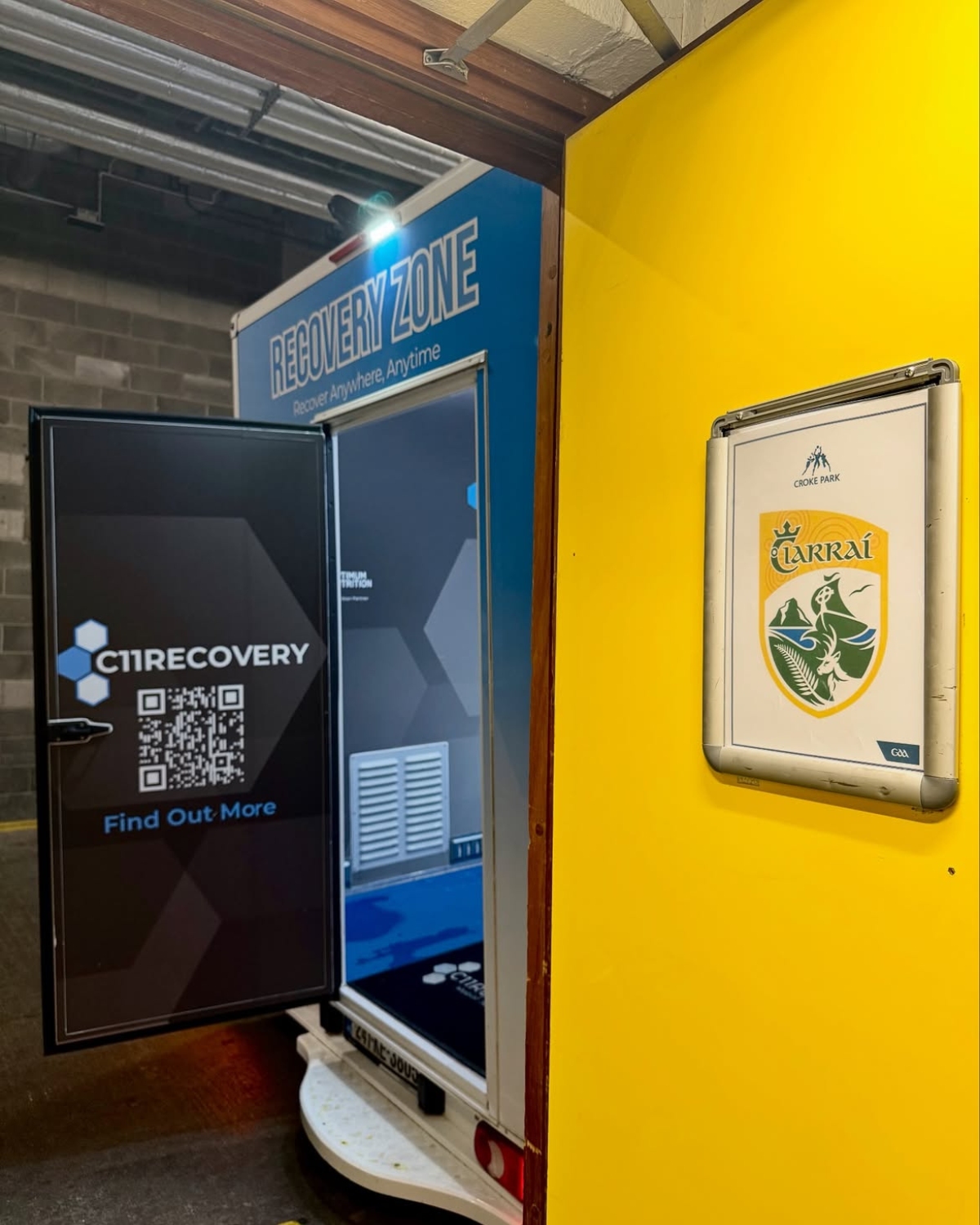
This is precisely the gap C11 works in — bringing the same cold and heat therapy tools used in professional sport to GAA clubs and individual players across Ireland, whether that’s a mobile recovery session after a match or a permanent ice bath and sauna setup at a club or in a player’s own home.
Cold water immersion (CWI) is one of the most researched recovery tools in team sport, and much of that research comes directly from contact sports with a similar physical profile to Gaelic games. A controlled study on rugby athletes performing a simulated collision-sport protocol found that CWI led to faster recovery of muscular force, voluntary muscle activation and muscle contractile properties, along with reduced perceived soreness, compared to passive recovery. Given the physical contact, high-speed running and repeated changes of direction shared between rugby and Gaelic games, this evidence translates directly to the demands GAA players face after a match.
Worth being precise about what that study did and didn’t show: cold water immersion sped up the return of muscle function and made players feel better, but it did not prevent the underlying muscle damage from happening. The value is in how quickly you’re ready to perform again, not in avoiding the damage in the first place.
A separate study on elite rugby players looked at chronic use — cold water immersion repeated across a three-week intensive training phase rather than after a single session — and found moderate reductions in fatigue and muscle soreness compared to a control group. The reductions in delayed-onset muscle soreness (DOMS) and creatine kinase, a blood marker of muscle damage, come from the acute research on immersion within 48 hours of exercise. Both matter for a GAA season, but they’re answering slightly different questions.
For GAA players juggling club and county commitments, the turnaround between a match and the next training session or fixture is often tight — sometimes under 48 hours. Research into rugby recovery notes that this compressed schedule is exactly when structured recovery strategies like cold water immersion matter most, since players frequently don’t have enough natural rest time to fully recover on their own before the next physical demand arrives. A short cold plunge session in the hours after a match or hard training session is one of the most practical, evidence-supported ways to close that gap. Our beginner ice bath routine covers the timing in more detail.
Heat therapy plays a complementary role. Regular sauna use is associated with improved circulation, reduced muscle soreness and better sleep quality — all genuinely useful for a player managing the accumulated physical load of club and county training across a long season, and covered in detail in our sauna health benefits guide. Pairing a sauna session with a cold plunge — contrast therapy — is increasingly used in team sport recovery specifically because the alternating heat-and-cold cycle appears to support faster clearance of the metabolic byproducts linked to muscle soreness, on top of the benefits either practice offers alone.
| What to do | Why | |
|---|---|---|
| After a match or hard session | A short cold plunge, around 10–15°C for several minutes | Faster recovery of muscle function and less next-day soreness, which matters most on a tight club–county turnaround |
| During the week, between sessions | Sauna use | Supports circulation, eases general muscle tightness and improves sleep ahead of the next training block |
| Across a congested fixture run | Consistent use of both, not just after the toughest matches | The chronic cold water immersion research shows the benefit builds across a training block, not from one-off sessions |
Professional GAA setups increasingly include dedicated recovery rooms, and that standard is becoming realistic for ambitious clubs and serious individual players too. C11 supplies and installs both the Avantopool cold plunge range and the Hekla sauna range, and offers mobile recovery sessions directly at training grounds and matches — bringing the same tools inter-county squads use to clubs and players who don’t have access to those facilities as standard.
Research on collision-sport athletes, including a controlled study on rugby players, shows cold water immersion supports faster recovery of muscle strength, activation and contractile function, along with reduced perceived soreness, compared to passive recovery — findings that translate directly to the physical demands of Gaelic games. It speeds up the return of function rather than preventing muscle damage.
GAA players train at an intensity that closely matches professional sport, but on an amateur structure without daily access to professional recovery facilities, and often with a tight turnaround between club and county commitments. This makes structured recovery tools disproportionately valuable compared to sports with built-in professional support.
Research consistently points to hamstring, groin and ankle injuries, along with a notably high rate of ACL injuries linked to the changes of direction, contact and jumping involved in both Gaelic football and hurling.
Research supports using cold water immersion after high-intensity or contact-heavy sessions, particularly when the turnaround to the next match or training session is tight. Consistent use across a demanding period, rather than only after the hardest matches, is what the evidence on repeated use supports.
Sauna use is associated with improved circulation, reduced muscle soreness and better sleep — all useful for managing the accumulated physical load of a season split between club and county training and fixtures.
Yes. C11 offers mobile recovery sessions at training grounds and matches, as well as supplying and installing permanent Avantopool cold plunge and Hekla sauna setups for clubs and individual players.
C11’s mobile recovery room brings professional hot-and-cold recovery straight to your club — to a training session, a championship match or a county final. It is the same kind of setup inter-county squads use, with nothing for the club to build or store. Check availability for your club, a competition or a club day.
For a permanent setup at the club or at home, we also supply and install the full Avantopool cold plunge and Hekla sauna ranges across Ireland. Get in touch and we will work out what fits your space and your budget.
Our mobile recovery room brings professional hot-and-cold recovery directly to your team or event. Sports clubs, competitions, corporate days and wellness activations, anywhere in Ireland.

So we can show you the right prices and delivery options.
All prices include VAT. You can change this any time.